

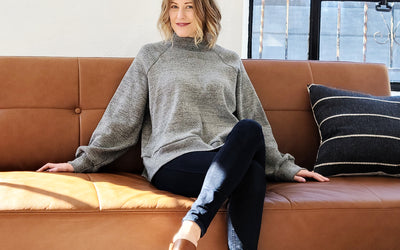

Welcome to the Tumalo Knit Jumpsuit sewing tutorial.
The Tumalo is a pretty quick and simple sew, but I know how helpful it is to have a tutorial - especially if you are new to sewing with knits.
There are two versions of this pattern (shown below), plus two hem lengths. Version A has plenty of coverage to be worn alone (or with a bra) while Version B has a very low neckline and deep underarms as it is meant to be worn with a top underneath. Both versions are sewn in the same manner so even though I am sewing Version A, this tutorial works for both A & B.

FABRICS & SUPPLIES
The Tumalo works with a multitude of knits. I prefer natural fibers so those are the fabrics I suggest, however, you can use whatever you prefer as long as it has at least 20% vertical and horizontal stretch (approximately). I used a white cotton french terry with natural rib knit trims here because I plan to eco print on the finished jumpsuit later this summer (see Nicola Brown of Clasheen who I met through Instagram). I also love these flower eco prints from the Billy Nou and the Dogwood Dyer, but then again, the flowers might make the jumpsuit look more like pajamas - I'm on the fence.
Anyhow, I set out to make a jumpsuit pattern that was suitable for knits without lycra and only mechanical stretch, however, lycra knits work with this pattern as well. Just note the difference being that lycra or spandex fabrics have more recovery so they fit a little snugger around the top.

Light and mid-heavy weight knits both work for this pattern, but it all depends on your needs. Do you want to make a winter version or a summer version? The fabric shown below is a cotton sweatshirt fleece. Not all fleece fabrics have stretch but this one from Lyrical Fabrics does have enough stretch, even without lycra. I also love that they offer matching ribbing. Be aware that heavier fabrics like sweatshirt fleece may be too thick and stiff for the trims so you may need to use a second fabric for the trims.
If you are stumped as to what fabric to use, here is a list of fabric suggestions and places to order them. And if you'd like to know what fabrics I used for the photoshoot samples, see the previous blog here.
Lyrical Fabrics - cotton sweatshirt fleece and matching ribbing; classic cotton jersey (other colors available); organic cotton/lycra jersey (other colors available); micro striped cotton/linen jersey; hemp/ organic cotton jersey (slub texture) also in black; french terry (other colors available) - matching rib available.
Iseefabric - cotton slub jersey (I used this fabric for the tan curvy version. It works well, however, it was marginal for the trim); cotton jersey, bamboo/cotton/spandex jersey; Supima cotton jersey .
Organic Cotton Plus - light hemp/organic cotton jersey; 7 oz hem/organic cotton jersey; hemp/ cotton/ lycra jersey.
Simplifii Fabric (Canada) - cotton/ modal/ spandex jersey
Blackbird Fabrics (Canada)- cotton/ modal/ spandex jersey (other colors available); bamboo/ cotton/ spandex jersey (other colors available); hemp/ organic cotton jersey (other colors available).
Natures Fabrics - bamboo/organic cotton/spandex jersey; cotton jersey (other colors but not all have enough stretch); bamboo/ merino/ spandex french terry; hemp/ organic cotton/ spandex jersey
Josephine's Dry Goods - cotton/ Spandex jersey; cotton/ linen/Spandex jersey
Bolt Fabric Boutique - bamboo/ Spandex jersey; cotton/ Spandex french terry
Style Maker Fabrics - cotton/ modal/ Spandex jersey
Stone Mountain & Daughter Fabrics - EcoVero viscose/ Spandex jersey; cotton/ Spandex jersey
Minerva (UK) - cotton/ elastane jersey; cotton jersey; cotton/lycra jersey; bamboo/cotton/ elastane jersey; cotton fleece back sweatshirt stretch knit
Maaidesign (Australia) - cotton jersey
Pattern Scissors Frock (Australia) - organic cotton/ elastane jersey; organic cotton/ elastane brushed sweatshirt fleece

cotton sweatshirt fleece with matching ribbing

This fabric is out of stock but they do have a modal/spandex sweathshirt fleece in this color here. Or other colors of the cotton sweatshirt fleece here. I just love that they offer matching ribbing and thread.
You will need a twin needle for knits for this project (they come in varying widths - your preference). A twin needle requires two spools of thread on the top of your machine, both threaded through the same places together until you reach the needles. The bobbin thread makes a zig-zag stitch between the two needles resulting in a stretch stitch.
If you can't find a twin needle, you can use a zig-zag stitch for the hems.

Other than that, you just need thread.
If you plan to hem your pants or shorts using a traditional, turned up hem, you may want to use a double sided iron-on stretch tape to make the hemming go more smoothly but it's not required. I've used Steam-A-Seam for this tutorial (shown below).
If you plan on making a raw edge, rolled hem, there's no need for this.

Let's Get Started!
Pockets
Trace the pocket stitching lines onto your FRONT PANT(5) pieces using the POCKET STITCHING TEMPLATE (13) and a washable fabric pencil or chalk. Align the curved edge of the pocket opening with that of the TEMPLATE as well as aligning the notches and upper waist.
Optional - For step 2 f., you can forego marking the pocket stitching lines and simply guide your stitching by feeling the ridge of the POCKET under the FRONT PANT as well as following the pins that hold the POCKET in place.

With wrong sides together, fold the POCKET TRIM (8) in half lengthwise and press.

Cut in half - to make two equal pieces.

With right sides together, pin one folded POCKET TRIM (8) to the curved pocket opening edge of the FRONT PANT (5). Slightly stretch the trim to fit.
Using your stretch stitch of choice (see page 3 of the instructions, Sewing With Knits) stitch the POCKET TRIM to the FRONT PANT with a 3/8”/10mm seam allowance, stretching to fit.
Note - I am using a twin needle in these photos to sew my garment together. I originally mentioned using a twin needle to construct the Tumalo in the instructions, but many of my pattern testers thought it wasn't a good idea so I changed it. However, I still think that if you don't have a serger, a twin needle stitch is as good as a lightening stitch or other stretch stitch (aside from serging).

The Pocket Trim attached (using a 2 needle stretch stitch here but use whatever stretch stitch suits you).

Press the seam down.

With the trim flipped upright and the seam allowance pressed down towards the pant, use your twin needle or zig-zag stitch, to topstitch a scant 1/8” away from the seam on the FRONT PANT side.
Your machine stitch length setting should be set around 3mm for topstitching.
Press and repeat these steps on the other side Pant/Pocket.

Optional - You may find that it’s easier to topstich the POCKET in place in the next step if you serge around the curved POCKET (7) edge first.
With right sides up, place the POCKET (7) behind the FRONT PANT (5), aligning the notches. Pin in place.

Note - You may find that the notches on your POCKET don’t align with the notches on the FRONT PANT. This is due to the pocket opening stretching a bit when applying the trim. Align the notches and try to steam the pocket opening back to its original size and shape.

Use a 2-needle topstitch or zig-zag stitch to stitch the POCKET to the FRONT PANT.

Stitch along the trace line of the curved outline or you can stitch by feeling the ridge of the POCKET underneath.

Baste the top and side edges in place.
Press and repeat with the other side.

Assemble The Body
With right sides together, pin the FRONT PANTS together at the center front rise. Using your stretch stitch of choice, stitch together with a 3/8”/10mm seam allowance.

Press the seam towards the wearer’s right side.

With right sides together, pin the BACK PANTS (6) together at the center back rise. Using your stretch stitch of choice, stitch together with a 3/8”/10mm seam allowance.

Press the seam towards the wearer’s right side.

With right sides together, pin the TOP FRONT (1 or 3) to the FRONT PANTS at the waist seams, aligning the center fronts and notches. Using your stretch stitch of choice, stitch together with a 3/8”/10mm seam allowance.

Press the seam towards the TOP FRONT.
With right sides together, pin the TOP BACK (2 or 4) to the BACK PANTS at the waist seams, aligning the center backs and side notches.
Don't be alarmed that the pant waist is larger than the top.

The BACK PANT waist is larger than the TOP BACK so pin the ends and centers together and then stretch the TOP BACK to fit the BACK PANT as you stitch them together with a 3/8”/10mm seam allowance using your stretch stitch of choice.

Press the seam towards the TOP BACK.

Using your twin needle, topstitch the waist seams of the Front and Back. Stitch on the bodice side close to the seams.
The seams may have been stretched out after sewing so press and steam the seams back into their proper shape.
Front

Back

With right sides together, pin the side seam of the FRONT and BACK together, aligning notches. Stitch together with a 3/8”/10mm seam allowance using your stretch stitch of choice.

Press the seam towards the back. Repeat with the other side.

With right sides together, pin the Front and Back shoulder seam together. Stitch together with a 3/8”/10mm seam allowance using your stretch stitch of choice.
Press the seam towards the back. Repeat with the other side.

With right sides together, pin the FRONT and BACK inseam together, aligning the crotch seam and notches. Stitch together using a 3/8”/10mm seam allowance and your stretch stitch of choice.
Press the seam towards the back.
Tip - Now is a good time to try on your jumpsuit to see if the strap length needs adjusting. It is better to adjust the straps now rather than after the trim has been added. You can also adjust the side seams and inseam if needed.

Trims
With right sides together, attach the short ends of the NECK TRIM (9 or 11) using a straight stitch and a 3/8”/10mm seam allowance.
Press the seam open. Repeat with the two ARMHOLE TRIMS (10 or 12).

Fold the NECK TRIM in half lengthwise so that wrong sides are together and the raw edges meet. Press.
Repeat with the two ARMHOLE TRIMS.


Find the four quadrants of the NECK TRIM and the halves of the ARMHOLE TRIMS.
1.) Lay the NECK TRIM flat with the seam at one end. Insert a pin at the seam and another pin at the opposite folded end. Repeat with the two ARMHOLE TRIMS.

2.) Now lay the NECK TRIM flat with the pins matching each other in the center and attach another two pins - one at each folded end.

Find the four quadrants of the garment body neckline and the halves of the armholes.
1.) Find the center front and center back neck by folding the top in half and aligning the shoulder seams. Place a pin in at the center front and center back necks.
2.) Lay the garment out flat and right side out with the center front and center back necklines aligned and front and back armhole edges aligned. Place a pin where the shoulder folds. The other half mark for the armhole is the side seam.
Apologies but I lost this photo but I think it's easy to understand.
With right sides together, pin the NECK TRIM to the right side of the garment neckline, aligning the center front, center back and shoulder pins of the NECK TRIM to the pins on the garment neckline. Place the seam of the NECK TRIM at the center back or just behind one of the shoulders seams (your preference).

Tip - Try basting your trim on first in case you find that your fabric is too stretchy or doesn’t have enough stretch. You can then easily unpick the basting stitches and take out some length or add some or cut a new trim if needed.
Using your stretch stitch of choice, stitch the NECK TRIM to the garment neckline while slightly stretching the NECK TRIM to fit the neckline in between the pinned quadrants. Press the seam toward the body.
Attach the armhole trims in the same manner, aligning the top pins and side pins.

Tip - Now is a good time to add a label under the seam at the center back neck.
Use a 2-needle topstitch or zig-zag stitch to topstitch the NECK TRIM and ARMHOLE TRIMS seam allowances down through all layers. Stitch a scant 1/8”/ 3mm away from the seam on the body side.

Hems
Option #1 - traditional two-needle hem
Try on the jumpsuit and determine the hem length.
I sometimes like to use a double sided iron-on tape when hemming knits. There are many different brands but I am using Steam-A-Seam.

Turn up the bottom pant hem 1 1/8”/2.9cm toward the wrong side and press. Repeat with the second pant leg.

Use a 2-needle topstitch or zig-zag stitch to hem the bottom pant leg 1”/2.5cm away from the bottom edge. Press. Repeat with the second pant leg.


Option #2 - Raw Edge, Rolled Hem
You may need to trim the hem to the correct length. Try on the jumpsuit and determine the hem length.
Secure the bottom of the seams as they may come undone after you've trimmed them. Secure them by stitching and backstitching the bottom inch of the seam allowance.
Stretch the bottom hem to encourage the edge to roll. Note that not all knit edges roll, but many do.
You can tack the rolled hems in place at the side and inseams if they have trouble staying in the rolled position.

TA DA! You've finished your Tumalo Jumpsuit - Congratulations!